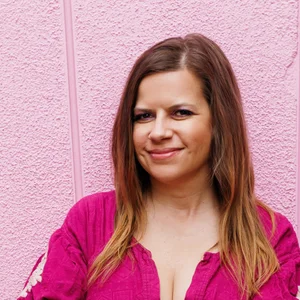
Podcast: Episode 1 Who Is Shay's Warriors Life After Cancer
Published: January 20, 2020 | Episode: 1 | Host & Guest: Elli Tourjé & Shay Moraga
Episode overview
Living Life in Color
What happens when cancer treatment ends, the doctors say congratulations, and the safety net disappears? In this debut episode of Life After Cancer, our host Elli Tourjé sits down with Shay Moraga, founder of the 501(c)(3) nonprofit Shay's Warriors, to discuss the raw reality of post-treatment survivorship.
Diagnosed at age 38 with aggressive triple-negative breast cancer, Shay shares how an intensely private experience turned into a thriving support community. From processing post-treatment depression and PTSD to discovering holistic self-care, therapy, and community movement retreats in the Coachella Valley, this episode sets the foundation for changing the conversation around life after surviving cancer.
Questions answered in this episode
In this debut episode, the conversation addresses what happens to a survivor's mental and emotional well-being once active treatment ends, specifically tackling how to navigate post-treatment depression, PTSD, and the loss of a clinical safety net after being declared "cancer-free." It answers key questions about Shay Moraga’s personal health journey – including how she managed an aggressive triple-negative breast cancer diagnosis at age 38 through 20 rounds of chemo, surgery, and 38 rounds of radiation – and details how a private Facebook journaling group evolved into Shay’s Warriors, a 501(c)(3) nonprofit filling the need for survivor support in the Coachella Valley. Finally, the episode outlines practical steps for life after cancer, answering how survivors can actively manage recovery through specialized therapy, movement like yoga and spin, proper nutrition, emotional vulnerability, and peer community networks.
Key discussion points & show notes
The Post-Treatment Gap: Why the transition from active medical treatment to No Evidence Detected (NED) can trigger unexpected fear, emotional disorientation, and isolation once the clinical safety net is gone.
Shay’s Diagnosis & Treatment: Facing a sudden triple-negative breast cancer diagnosis at 38, followed by a rigorous year of treatment: 20 rounds of chemotherapy, a massive lumpectomy, and 38 rounds of radiation.
From Private Journaling to Community: How a small, closed Facebook group started on Chemo Thursdays grew from a handful of close friends into an empowering support network of over 600 members.
Unmasking Post-Cancer Mental Health: Recognizing the delayed onset of depression and post-traumatic stress three months after finishing treatment, and the importance of seeking unbiased, cancer-focused therapy.
Holistic Pillars of Healing: Rebuilding physical and mental strength through tailored nutrition, body movement (yoga, spin, HIIT), and learning the strength found in emotional vulnerability.
Building Shay’s Warriors: How the need for localized survivor services in the Coachella Valley inspired the launch of a 501(c)(3) nonprofit offering wellness retreats, movement events, and connection for survivors.
Notable moment
“You go through cancer and everybody is by your side... then the day comes that your doctor says, ‘Today’s your last day... Congratulations.’ You walk out of there and you’re like, ‘Yes, I’m done.’ And then a few days later, you start to think... ‘What do I do now?’ ... It’s about being grateful to live in the moment and realizing this is my second chance at life. This is living life in color.””
Resources & links mentioned
Official Website: Shay's Warriors
Get Involved: Learn more about upcoming survivor retreats, community events, and local volunteering opportunities at shayswarriors.org.
Full transcript:
Elli Tourjé
This is the "Life After Cancer" podcast.
Elli Tourjé
Bringing stories of inspiration, survivorship, and vulnerability, put together by Shays Warriors. Shays Warriors is choosing to live hope in color.
Elli Tourjé
"Life After Cancer" is a community that inspires, informs, and empowers you to live in hope to change the conversation around the terminology of cancer.
Elli Tourjé
Today on the program, the founder of Shays Warriors, Shay Moraga, is here. And we're— we're just doing this thing together from scratch. Day 1, very beginning: "This is it." Excited. We're doing it.
Shay Moraga
We're doing it. Yeah.
Elli Tourjé
Shay, it's awesome. So we've just kind of opened this whole new thing to to talk about something that's very near and dear to everybody. Everyone's been touched by cancer in some form or another.
Shay Moraga
Yes.
Elli Tourjé
And you, too. And so you've put together an amazing tribe of people to talk about things and talk about life after cancer. And that's what this show's going to do. Welcome.
Shay Moraga
Thank you. So excited.
Elli Tourjé
All right. We like the music. We don't want to turn it off. We're like, "I'm— I'm really digging this music."
Shay Moraga
It's like a dance party.
Elli Tourjé
I know. And you know what? Dancing, they say, actually makes your mind younger, your brain stronger. So this is a part of the show where we should dance.
Shay Moraga
We should.
Elli Tourjé
But instead, we're going to get—
Shay Moraga
I can't sing. I mean, you could sing, but I can't sing.
Elli Tourjé
I can— you know, my friends say I can sing sometimes. So this is all about building communities of warriors, starting with Shays Warriors, which began kind of small.
Elli Tourjé
And it began— it began small, like maybe like cancer begins small and turned into something that could have been really not so great and turned into some real awareness of what all of us can be a part of when it comes to the community of people after surviving cancer.
Elli Tourjé
And then that— that moment when you've been prescribed that your cancer's over. That's what Shays Warriors is. It's that unique little place after someone's had cancer.
Shay Moraga
Yes. You know, you— you go through cancer and everybody is— is by your side and rallying you on, and you're in that safety net of your doctors and your nurses and— and your family and your friends.
Shay Moraga
And then and then the— the day comes that you've been waiting for all this time, and your doctor says, "Today's your last day. Today— today's your last day of treatment, and we'll see you in six months or three months or whatever it is. Congratulations."
Shay Moraga
And maybe in some offices, they get to ring a bell or they get to, like, have this, like, little celebration. And then it's great, and you want to— you want to be excited, and you walk out of there and you're like, "Yes, I'm done."
Shay Moraga
And then a few days later, you start to think, like, "Oh my gosh, everybody's like, I'm not going back there. Like, what do I do now?"
Elli Tourjé
Mm-hmm.
Shay Moraga
And then the months—
Elli Tourjé
Because— because what happens— and I've not been in it personally, but I've been around it enough to see that what happens is that as soon as someone is diagnosed with that C word, right there's a whole— whole huge gamut of emotions. But not just that. There's support in different ways. There's choices. There's education. You're— it's just a whole new world has opened up.
Shay Moraga
Yes.
Elli Tourjé
And then— and then that day comes when they say you're all done, and that world is just still hanging over your head.
Shay Moraga
It is, because even though the cancer might be dormant or gone or in remission or whatever it is, your mind is still thinking, "When is it coming back?" When, you know, you don't want to think that way. But for some reason, the aches and the pains and everything, you're like, "Oh my gosh, you're ultra-sensitive now to everything that's going on within your body." So, yeah.
Elli Tourjé
So, Shay, you were very young at the time that you were diagnosed with a particular kind of cancer.
Shay Moraga
Triple negative.
Elli Tourjé
Triple negative breast cancer.
Shay Moraga
Yes.
Elli Tourjé
And you were just in your 30s, right?
Shay Moraga
Yes. 38.
Elli Tourjé
38.
Shay Moraga
Yeah.
Elli Tourjé
And it was like, "Hey, surprise, surprise. Now what?" You were a very private person.
Shay Moraga
I was.
Elli Tourjé
You were a very private person. And you had an opportunity to not be private anymore. And you started by— I think where I saw you is you began with a small Facebook group. You were inspired by actually someone who's on the board of Shays Warriors.
Shay Moraga
Yeah.
Elli Tourjé
Which is a 501(c)(3).
Shay Moraga
Correct.
Elli Tourjé
Shayswarriors.org. If you want to follow along, S-H-A-Y-S warriors, W-A-R-R-I-O-R-S dot org. What a coolest website you're ever going to lay your eyes on. You just got to check it out. Anyway, so you were inspired by Paula.
Shay Moraga
Correct.
Elli Tourjé
To begin—
Shay Moraga
Our good friend.
Elli Tourjé
Yes. To begin writing about your stories.
Shay Moraga
Right.
Elli Tourjé
And— and how did that make you feel? Because you— were you a writer before that?
Shay Moraga
No. I don't think I was a writer. I mean, in fact, I— I always thought, like, I was horrible, you know, writing. And so I never— never really wrote. And my grammar isn't that great or anything.
Shay Moraga
And Paula was like, "You know, this is going to kill you if you keep it inside. Please, please write about it. Get— have a way to talk about it."
Shay Moraga
So we started off with a little bit of people, and I— I agreed to it only if she kept it as a closed group.
Elli Tourjé
Mm-hmm.
Shay Moraga
And our close friends. And as more and more people found out I had cancer and they reached out to me, I felt more comfortable to share with them because it was an easy way for me to get out my emotions and my feelings, and then they were right there talking back to me.
Elli Tourjé
And as I recall, because I followed along on Facebook, it was on Thursdays that you— that you posted.
Shay Moraga
It was. It was. And that was my chemo day.
Elli Tourjé
That was your chemo day.
Shay Moraga
Yep.
Elli Tourjé
And you went from being a yoga instructor, fitness instructor, and mom extraordinaire.
Shay Moraga
Yep.
Elli Tourjé
And of course, you have a wonderful company Leasing. Is it Leasing?
Shay Moraga
Yeah. It's property management.
Elli Tourjé
Property management company in another part of the world. Anyways, so you went from— from being that to now you were just going to start sharing your story.
Shay Moraga
Yes.
Elli Tourjé
What— what was that like, sharing your story? And what ensued after you shared your story? Was there any kind of— let's go— tell me what it was like sharing it, and then we'll find out what happened from there.
Shay Moraga
Sharing it was really, really scary at first because I've never shared anything that personal and close to my life and what was going to happen. I mean, I was scared because I didn't know what was going to happen to me. I didn't know what was going to happen to my daughter or anything like that.
Shay Moraga
And it was— it was an easy way to share with close friends and— and keep everything all in one place. And they could— my friends then could figure out who was talking to each other and all of that. So that private Facebook group was brilliant on Paula's part.
Elli Tourjé
Did it— did it stay private? Is it still private?
Shay Moraga
I don't think so. No. You can join it. Anyone can join it now.
Elli Tourjé
And how many— how many people are— there's a few now.
Shay Moraga
There's a little over, I think, 600 people now.
Elli Tourjé
Okay. Okay. And that's just a small community of— it started off with about, like, 8, 10, 15 people.
Shay Moraga
Yeah. Yeah.
Elli Tourjé
And it got bigger and bigger. And and we— we started to learn. People like me who'd never really— I mean, I have people in my family that have had cancers in different ways and different symptoms, just different stages of their lives.
Elli Tourjé
But I was never in the middle of what it was like to— to be there until I read your stories of what you woke up with and how you went to sleep and your fears and your your greatest discoveries and your joys and successes.
Shay Moraga
Yeah. I had to reframe my way of thinking and my mindset going through it because I think before cancer, I looked at the world one way. And then after cancer, it went— when I was going through cancer, I started looking at it very differently because being in a chemo room among maybe 20 or 30 other people, you see myself.
Shay Moraga
I was very blessed with girlfriends coming and going all the time, checking on me, picking me up and dropping me off. And then I might see other people in the chemo room who had nobody.
Elli Tourjé
Mm.
Shay Moraga
And it's not to say that they were alone, but it's to say that they were fighting and scared and probably fearful just as much as I was.
Elli Tourjé
You know, I— I think about a 38-year-old woman who has breast cancer and a 58-year-old woman. Were you treated any differently because of your youth? I mean, were doctors like, "We got to get this thing right away"? Or— or did you just see that there were people of all ages in there?
Shay Moraga
I think because of the type of breast cancer that I had and because of my age, being younger, yeah, I think I— I— they rushed me in pretty quickly because the breast cancer was very aggressive.
Elli Tourjé
Mm-hmm.
Shay Moraga
And my understanding was growing pretty rapidly. So, yeah.
Elli Tourjé
So you went in, you had your chemo, and then did you have any surgery that followed?
Shay Moraga
I did. I had the 20 rounds of chemo, and then I had a little break, and then we did our surgery. And it was a massive lumpectomy. And then I had another break, and then I had 38 rounds of radiation.
Elli Tourjé
Wow. That's.
Shay Moraga
Long year.
Elli Tourjé
A long year. Okay. So this is where Shays Warriors comes in. So you're 38 years old. You do a year. You're— you're under 40 now. And all of a sudden, you're a cancer survivor.
Shay Moraga
Mm-hmm.
Elli Tourjé
What does— what does that mean?
Shay Moraga
Wow. I think it's the fact that I'm surviving on a daily basis now. I just— it— it is day-to-day.
Shay Moraga
It's about being grateful to live in the moment not get so wrapped up in the big things of life, but, you know, or the small things in life, but, like, really continue to see the beauty that we have and to realize this is my second chance at life.
Shay Moraga
This is— this is a new world. It is living life in color now.
Elli Tourjé
Mm-hmm.
Shay Moraga
Where maybe before I was just black and white.
Elli Tourjé
Wow. That's really cool. Or beige or.
Shay Moraga
Right.
Elli Tourjé
So this was an opportunity to get to know the person that was inside that didn't have to face any big fears or anything. Because, I mean, life— life and death, you're like, "I'm going to die" or "I'm not going to die." And that's what people go through.
Elli Tourjé
So— so there— there you are with all that. And you got a little time on your hands. Not a lot of time, a little time, but you know how they say if you want something to get done, you give it to somebody who's kind of busy.
Shay Moraga
Right.
Elli Tourjé
Wow. So you have this— this time to— to really consider what it was like when you woke up and— and you're, "Okay, you're all better. See you in a year." And then that brought about some kind of depression, didn't it, or?
Shay Moraga
It did. It wasn't until about three months after they said I was NED, which is no evidence detected of the cancer cells in my body.
Elli Tourjé
Mm-hmm.
Shay Moraga
That something hit me and the emotions started to flow. I would cry all the time and I would— I would not want to leave my house. And I— I wanted to literally go back to the— I wanted to go back to the— the chemo room and just be there because I felt safe.
Elli Tourjé
Hmm.
Shay Moraga
I also felt safe at home. And— and I didn't know that that was depression. I didn't know that that was starting to be maybe a little post-traumatic stress syndrome as well.
Elli Tourjé
Hmm.
Shay Moraga
Because it was— it was my safety net for a long time. And— and a lot of people, too, they— you know, your friends, your family, there's no— there's no right or wrong reason. They just— they go back to their normal lives, you know?
Elli Tourjé
Right.
Shay Moraga
You're— you're okay now. But the thing that that I try to explain to people is we're not always okay.
Shay Moraga
And the fact that even though our hair starts growing back and our eyelashes and eyebrows and we look like we're not sick anymore, our mind is still playing tricks on us. And it's trying to get over that hump of— of continuing to live life to its fullest and remind ourselves that constantly and daily because we still have this fear deep inside that— that cancer wants to come back. And you don't want it to, of course.
Elli Tourjé
So that's who we're talking to today.
Shay Moraga
Yep.
Elli Tourjé
We're talking to you if— if that's you. If you are living in the fear that this thing's going to return every day, do you have the kind of support? Do you have the tools? Are you doing the things that make you feel better, that make you better?
Shay Moraga
Yes. I would say that yes, on a daily basis now I continue to eat healthy.
Elli Tourjé
Mm-hmm.
Shay Moraga
As healthy as I did when I was going through my treatments. I have— I decided to go to yoga or HIIT classes locally in town. I go to spin classes. I mean, I teach, but I also go to those classes for myself. I love to— to do that.
Elli Tourjé
Mm-hmm.
Shay Moraga
And that also helps my mindset and my mind frame. And I recently started seeing a therapist.
Elli Tourjé
Yeah, you do.
Shay Moraga
Specifically because.
Elli Tourjé
Best thing ever, by the way, people. It's a good thing.
Shay Moraga
It really is. And, you know, I think before I was kind of like, I felt ashamed that I had to go see somebody.
Elli Tourjé
Right.
Shay Moraga
But it really does help to talk to somebody who understands and specifically deals with cancer.
Elli Tourjé
Yeah. You know, and that's one of the things, too. I don't— you know, I— I would never want to say, like, "I'm— I'm strong in my faith and I spend time meditating and I do this." But can I tell you something? That stuff in your unconscious mind, the things that you've learned to fear in the, like, those base units of time when you were a child, that, you know, they're going to reflect in your answers and in the way you think about something.
Elli Tourjé
So you could be told that you're done with whatever you're done with, but if you still have that mindset that doesn't understand, and you don't even understand it I— I think that that would be one— one of the biggest prescriptions as a non-therapist, a non-professional, just a radio person that's been talking for a long time, playing music for y'all, too. That's probably one of the best things you can do is let someone else take a look at how your brain's working.
Shay Moraga
Yes. Well, and they're unbiased. They're not— they're not in your sphere of friends.
Elli Tourjé
Yeah.
Shay Moraga
They are professionally trained to deal with the things that are in your mind and, you know, give you— give you tools to help heal.
Elli Tourjé
So you've got the— you've got the nutrition part, self-care. That's part of the self-care and the working out, taking care fitness. That's— that's all great.
Shay Moraga
Yeah.
Elli Tourjé
And let's just say you're super depressed. Where do you start? I mean, what do you do if you don't want to leave your house? Like, how did you get out of the house? I think did you— was it maybe because you had surrounded yourself with people that said, "Get out of the house. Somebody come get you."
Shay Moraga
Honestly, it was just a friend that I was talking to, and she said— she goes, "You know, Shay, you sound a little depressed." And I go, "You know what? I think I am." You know, and luckily for me, I guess, I was— I was like, "You know what? I need to swallow my ego and my pride and just I need to get help."
Shay Moraga
So I reached out to someone that I look up to and who is a— who is a doctor in my— in— in the cancer field. And I said, "Hey, do you have any referrals for me? I really need to talk to somebody." And of course, she sent me a— a list of a couple different people. And that's how— that's how I did it.
Shay Moraga
And I called right away because I knew for me that I was starting to enter a really dark place. And that was— that was scary as well because.
Elli Tourjé
Because you can stay there for a while.
Shay Moraga
You can.
Elli Tourjé
And you don't realize how long you're there.
Shay Moraga
Yeah.
Elli Tourjé
You can be there and life can just keep going by. And there's probably people listening today where they have been there. And the easiest thing for you to do— it's not really easy, but it's to just kind of tell somebody.
Shay Moraga
Yeah.
Elli Tourjé
That'd be that the first step. Maybe they can set you up with somebody, right?
Shay Moraga
Exactly. Exactly.
Elli Tourjé
And— and give you a reference for someone because really, you're happy for the most part. I mean, I'm sure you're also embracing life the way it should be, but that— that piece of it.
Shay Moraga
Right.
Elli Tourjé
Yeah. So beyond that point where you realized that you needed some kind of help. So that was really a realization for you. Is that one step of, you know, we talked about calling somebody and having somebody have— you know, you call someone and get some help.
Shay Moraga
Yes.
Elli Tourjé
So this began to change things around. And this is when you start to think about it was Shays Warriors was a Facebook page, but then it— then how did it become a nonprofit? And how— speaking to the listeners today, what— what can we expect from this show?
Shay Moraga
It became a nonprofit a while back when I sat down with Eileen who is a good friend of mine and also had gone through breast cancer. And I said we, you know, it would be awesome if there was a we started off with, like, a yoga event because that's what I do. And it would be like a retreat, a retreat for us to kind of go come to and talk and— and be able to just get things out emotionally and— and move with movement and whatnot. And of course, she loved it. And she's like, "Yeah, let's do it." And so we started working on that probably about a year and a half ago.
Shay Moraga
And just recently, someone then said, you know, "Why don't you just— why don't you put it into a nonprofit?" After we— we reached out to one of the nonprofit attorneys in town. And I'm like, "Yeah, I mean, I— I never thought about it being a nonprofit, but that's— that's yeah, why not?" because there are other services for survivors and life after cancer that— that are needed.
Elli Tourjé
Mm-hmm.
Shay Moraga
And there was Gilda's Club that was out here, and it— it recently closed down. And there was a lot of good— good services there. And so not that we'll ever be a Gilda's Club or anything like that, but but there— there does— there is a need in the market in the— in our— in our community, not market, but there's a need in our community for services for survivors.
Elli Tourjé
Is that something that— I mean, we talk about this being kind of a global community as well. Are there communities that you model this after? Are there places that you've seen do this well? Are people doing this well?
Shay Moraga
Yes. I mean, I'm— I'm sure there are. There's— there's lots of places. There's— I know there's women on up in Washington or Portland, and they do, like, a fly fishing survivors retreat.
Elli Tourjé
Cool.
Shay Moraga
There's retreats out in New Jersey.
Elli Tourjé
Mm-hmm.
Shay Moraga
As well. And— and I want to say there's a— there's a boating retreat. And my friend Sarah, who you'll talk to in a little bit, she probably knows a lot more about that than I do.
Shay Moraga
But but yes, there are— there are places out there that— that do stuff for survivors. There's just— there just wasn't one in our community anymore. And I know myself and I know a lot of other survivors that that need— need some extra services.
Elli Tourjé
And so what I think of— so this is the Coachella Valley where we are recording this podcast. And it's been known for years as the place where people come to unwind and take the waters. I know as people that came here in the '40s and '50s, they came to take in the waters in desert hot springs in different areas. And it was supposed to be some kind of therapy and healing.
Elli Tourjé
So I would think that naturally, if— if you're up in Washington in that area, that makes sense. The water there is something that it provides, you know, a lot of— a lot of fish and— and fisheries and streams. And people can do that all the time.
Elli Tourjé
If you're in the Coachella Valley, you're going to look at a place that provides the healing in the— and one of the biggest spa known places in the nation the Coachella Valley is, in fact, they have the wellest. They call them the— it's called the wellest. It's— it's really providing so many spa activities for people and ways for them to get well.
Elli Tourjé
So I would think even if you're listening, in your community, there'll be something that you— if people wanted to start this or they wanted to look into, it'd be something that has to do with the area they live in. But you can leave and also come to one of these yoga retreats, right?
Shay Moraga
Yes.
Elli Tourjé
So you could leave Punxsutawney— what is it? Philadelphia? Isn't that where Punxsutawney Phil?
Shay Moraga
I don't know.
Elli Tourjé
Punxsutawney Phil is the guy the gra— the groundhog that wants to see its shadow. So in February.
Shay Moraga
Yes. So
Elli Tourjé
yeah. So when it's cold and nasty out in the middle of nowhere, that's when you come to the Coachella Valley, and that's when you do the yoga retreats, or that's when you come and you get around a lot of other survivors who will tell their stories and share their time and the things that have worked for them.
Elli Tourjé
And then you begin to have these closer relationships with people that you never thought you would ever have a relationship with.
Shay Moraga
Correct. Survivors— survivors creating a community of friends and and— and tribes, I guess. Yes. Yes. And them being able to go back to their communities and figure out how they can get back involved, whether it's volunteering or starting— starting an event like that but so that they collaborate together because cancer— people with cancer are understood very well by other people with cancer.
Elli Tourjé
Mm-hmm.
Shay Moraga
That have had cancer.
Elli Tourjé
And the rest of us is like, "I'm sorry. I'll pray for you. What can I do? Can I drive you? Can I—" and, you know, you don't even know you might be that person in need three months, three years.
Shay Moraga
Yeah. You don't know what you don't know, right?
Elli Tourjé
Right. Right. And that's— that's really important, too, because I think that if you are willing to be around somebody that's a survivor and that hasn't really— I mean, you don't have any reason to, like, be afraid, but I think there's a lot of fear. There's a lot of fear around people that.
Shay Moraga
There is. And that's where the language and the mindset, if we can turn that around to do good.
Elli Tourjé
Mm-hmm.
Shay Moraga
Because of what we've learned.
Elli Tourjé
Mm-hmm.
Shay Moraga
Volunteering within that community to help lift other people up.
Elli Tourjé
And you talked about.
Shay Moraga
Makes a huge difference.
Elli Tourjé
It does. I mean, you talked about changing the terminology around cancer. Now, I understand cancer as it's your— it's your cells. Those are your cancer cells. They don't belong to anybody else. You ha— they're there for a purpose. That purpose is to take over.
Elli Tourjé
They're the cells, and they get stronger. And so it's— it's the mindset that's involved by saying, "No I don't want you to take over anymore." It's the treatment. It's everything around it.
Elli Tourjé
But it's not something apart from you. It's— but it's something that does not have to be a part of you. And it's getting through all of that that is just— it's just so sublime. There's so much to it.
Shay Moraga
Well, you have to— you have to be vulnerable. You got to open yourself up and open your heart up and be vulnerable to allow others to help you.
Elli Tourjé
Mm-hmm.
Shay Moraga
And if you were like me, a lot of us, we want to do it ourselves. We want to do it our own way.
Elli Tourjé
And I think that vulnerability, too, is what allows you to— I mean, really, so much of what our sicknesses are is because of our inability to be vulnerable.
Shay Moraga
Mm-hmm.
Elli Tourjé
And whether it's the help of a doctor or the help of a friend or the help of a pastor, whatever it is, the help that you need, there are a lot of ways to get that. And after— after life after cancer, this podcast is really not about having cancer as much as it is as, "Okay, the cancer's over. Now what?"
Shay Moraga
Right. Now it's living life in color.
Elli Tourjé
Mm-hmm. Living life in color. I just love that. And that's— that's what we want to do. We want to live life in color.
Shay Moraga
That's right.
Elli Tourjé
I think I like that. Live life in color. Life after cancer.
Shay Moraga
Absolutely.
Elli Tourjé
So the founder of Shays Warriors, Shay Moraga, here to talk today. She'll be back and forth in and out of the program as we continue this wonderful podcast. This has been our first episode. It's pretty exciting.
Shay Moraga
Thank you.
Elli Tourjé
So let's direct people where they can go again to find out more about Shays Warriors.
Shay Moraga
Elli Tourjé
All right. Until next time, we’re out.